
Hydropower plants in the EU could accommodate 18% of new renewable energy capacity without grid expansion
Around 18% of the planned wind and solar capacity across seven of the European Union’s key hydropower markets could be connected to the electricity grid without requiring new infrastructure. This is according to an analysis by Ember, which found that existing hydropower plants have unused grid connection capacity that could be utilised through hybridisation—the connection of new renewable energy installations at the same grid connection point.
The study covers Austria, Bulgaria, France, Italy, Portugal, Romania and Spain, which together account for 93 GW of the EU’s total 131 GW of hydropower capacity. According to the report, this approach could enable a combined 25 GW of new renewable energy capacity to be connected without expanding the grid.
What Is Hybridisation?
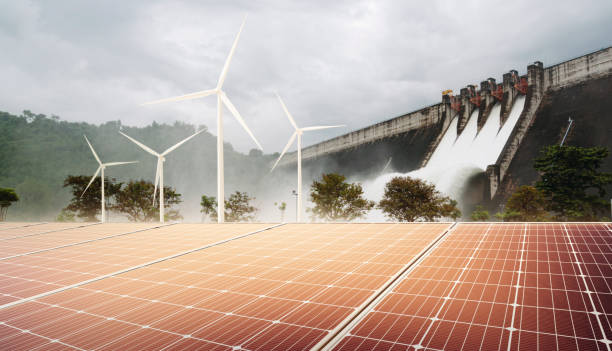
Hybridisation is a model in which an existing hydropower plant and new wind or solar installations share the same connection point to the electricity transmission grid. Instead of constructing new power lines and substations, the new capacity makes use of the existing infrastructure.
This is possible because many hydropower plants do not continuously utilise the full capacity of their grid connection. On average, they operate at only around 19% of the capacity available through their grid connection, as they often generate electricity mainly during the morning and evening hours, when demand is highest. During the remaining periods, the unused capacity can be utilised by solar or wind power plants.
According to Ember, such combinations can nearly double the utilisation of existing grid connections and, in some cases, even triple it. In addition to reducing the need for investment in electricity transmission infrastructure, hybridisation also enables new renewable energy projects to be connected more quickly.
Austria Leads, While Bulgaria Lags Behind
Austria has the greatest potential, with 5.2 GW of its planned 6.8 GW of new renewable energy capacity capable of being connected through existing hydropower plants. It is followed by France, with 4.5 GW out of a planned 17.8 GW, and Romania, where 1.8 GW of the planned 10.4 GW could be developed in this way, equivalent to 17.3%.
Bulgaria ranks last among the countries included in the analysis. According to the findings, only 150 MW—or 6.8% of the planned 2.2 GW of new capacity—could make use of existing hydropower grid connection points.
Nevertheless, Bulgaria’s state-owned National Electricity Company (NEK) is already working to convert several hydropower plants into hybrid facilities by adding battery energy storage systems. The company is also exploring the possibility of constructing two floating solar power plants on existing reservoirs.
Why Does This Combination Work?
Solar power naturally complements hydropower generation. While hydropower plants operate most intensively in the morning and evening, photovoltaic installations produce the most electricity around midday. This allows the same grid connection to be used significantly more efficiently.
The benefits are even greater for pumped-storage hydropower plants. If, at a particular time, the solar power plant generates more electricity than the grid connection can accommodate, the excess energy can be used to pump water into the upper reservoir. Instead of curtailing production, the energy is stored and can be used at a later stage.
Wind power can also be successfully combined with hydropower. Although the complementarity is not as pronounced, the seasonality of wind generation in Europe largely coincides with periods of higher electricity demand, making such hybrid projects economically viable.
Hydropower plants located within protected areas were excluded from the analysis. As a result, around 28% of the large-scale hydropower capacity in the countries examined remains suitable for hybridisation.